
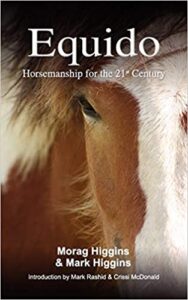
If you’ve had horses in your life for any length of time, you probably have a few stories. Like most of ours, some are funny, some are touching and some are sad. What you will find in Equido Horsemanship for the 21st Century is just that, a way of thinking told from a point of view that is both compassionate and at the same time practical. What you will find here is not only a good book but also the wisdom learned and lessons horses teach us about them, life and also ourselves if we but choose to see.
Morag and Mark Higgins have been friends of ours for several years. They both practice the martial art of Ninjitsu and Aikido, respectively , and are two of the funniest and fun loving people we know. Their book contains much of their own unique brand of humour, and even amongst the times when the stories are emotionally provocative, the heart they have for their life and especially the horses under their care shines through. We also have the beautiful offerings of poetry from Mark that give us a glimpse into his deep connection to horses and all the gifts they give. (His poem “Home” is one of our personal favourites.
While Morag imparts knowledge in a way that owners will benefit from in their own horse care and management, she also addresses topics that she finds important to pass along. She is honest and forthright in her telling, and we have no doubt that she is an advocate for the horse. Her teachings on animal communication and horse awareness will open the readers mind and allow them to look at things from a different perspective.
What a gift it is to have such open access to the beauty, wisdom, kindness and knowledge that Morag and Mark share with us in Equido Horsemanship for the 21st Century. We are sure you will enjoy and treasure it just as much as we have.
Mark Rashid
Crissi McDonaldd
Estes Park, Colorado, U.S.A.
June 2010
A comment from Morag:-
You will not find any fancy techniques or gadgets in this book, this is not about teaching you things you can do to your horse, instead, it will teach you how to be with your horse, how to understand them and how to make their lives better by improving yourself and your way of thinking. All of the Equido work was inspired by Mark Rashid and his unique ethos and I would like to thank him personally for helping us make this world a better place for the horse.
 Fisher King Publishing Ltd.
Publishers & Agents
t: +44 (0) 1845 526194 m: 07738 413 262 www.fisherkingpublishing.co.uk
FIRST CHAPTER
EQUIDO CHAPTER ONE
Horsemanship for the 21st Century
Our relationship with the horse changed throughout the ages with each era bringing with it new ideas and revelations. This changing relationship has not always had the horses’ best interests at heart and more often than not they found themselves getting the worst of the deal.
It may surprise you to learn that today there are more horses in the U.K. than there were before the Industrial Revolution, when the only “horsepower” was quite literally equipped with four legs. Now most people keep horses through choice rather than necessity and it should therefore follow that at last the human/horse partnership has a chance of growing into something quite special.
This book is an introduction of sorts into the world of Equido. Equido is more than an equestrian qualification, it is an ethos, a way of thinking and interacting with your horse that should enable you to step into a world of possibilities that you did not even know existed. Equido strives to show you a knew way, fit for this new century, of looking at all manner of horsemanship, from stable management, training, competing and rehabilitation, all from the horses’ point of view because it is only when we look at things through their eyes that we can truly understand what it means to be a horse and understanding is the first step in communication.
You may have seen or heard about great horsemen and women and how they seemed to have a natural empathy or feel for a horse. They seemed able to almost “think” with their horses till the line between human and equine became blurred. You may (like most people) have wondered what this illusive feel actually was, what it meant to the rider and the horse and how it impacted on they way they work together. Many of you may even have been inspired by these horsemen to take your first tentative steps into the world of horses.
As you began to learn about the art of horsemanship and riding you may even have asked various instructors what feel was and may have received a multitude of different answers making the mystery of this empathy all the more intangible. How could something so obvious in some people be so difficult to understand and teach? The truth of the matter is that it is not difficult to learn or teach if you know how. Equido was developed to do just that. I have been riding now for over 37yrs and teaching for 30 of those years. I have had the privilege to have known and worked with many, many horses in my career and although I have always felt that they was something new to learn from every horse, it was only recently that I found a path to follow where I could for once truly listen to what they were saying.
I have had a very varied riding career, having participated in several disciplines such as jumping, dressage, one day eventing, showing and now western riding. I look back at the horses I have known and feel humble to have been taught by them.
One day I saw a QED program about a Cowboy called Monty Roberts. I was amazed by what I saw. I immediately contacted his organisation and asked where I could learn his methods. He immediately put me in touch with Kelly Marks and the Intelligent Horsemanship Association and so I started on the journey of Natural Horsemanship. I began my studies with the Intelligent Horsemanship Association in 1999 and qualified 2yrs later becoming the first person in Scotland to do so. I was made the Recommended Associate for Scotland in 2002 and continued in this role for four years.
Over the years I learned so much from the troubled horses I was working with and I began to build on and expand the techniques I had been shown. The moment of real revelation came when I had the really good fortune to ride on a clinic with top American trainer Mr Mark Rashid in 2005. I was truly inspired. Mark Rashid is not only an exceptional horseman but human being as well. A fellow Martial Artist, I instantly understood his ethos and he has been the real inspiration that has guided me down the path leading to the development of the Equido Training system.
I can honestly say that my training experience with Mr Mark Rashid has changed my life and changed me as a person. I have become a much better rider, more receptive and responsive to the horses I ride, I can now listen to what they are saying and feel how to correct any issues they may have. It was a revelation to me that riding could be taken to such a level where you only need think “half pass” and your horse would carry out your command with freedom and ease. No spurs, no double bridle, no whips, no aids, just pure co-operation and willingness from the horse to please and a meeting of minds.
This way of living influences every single thing we do with our horses, right from the moment we step into their world, be it mucking out, making feeds, leading, grooming, rugging etc, it is not just about when we sit on their backs and expect them to obey. Equido teaches you how do have feel for everything you do with the horse, it is about the big picture, the whole picture. We know that a horse who is not cared for or handled properly will not be in a good or happy state of mind and this in turn will affect their performance when being ridden.
I often ask my Equido students about the difference between their riding and a top Grand Prix dressage rider. Some laugh and start to list a whole series of “things” that make them think they are inferior riders to the top dressage elite. They are often taken aback when I simply say that there is no difference between them and a top rider other than their timing and the application of their aids. The one thing that separates most riders from the top echelons is this illusive feel. A really good rider will have trained themselves to “listen” to their horses, to “feel” what they are thinking and anticipate any questions the horse may be asking and correct them in the blink of an eye. A Grand Prix horse may be spooky or fresh and may want to shy away from the pretty flowers round the ring or throw in a buck out of sheer enjoyment. A Grand Prix rider will be able to “feel” this excitement and tension in their horse or the anxiety they may have and will be able to override these emotions with calm and focus sent down through their seat and reins and expertly applied aids to correct any potential deviation from their tests. The overall picture is one of complete harmony as the horse seems to do the test themselves and the rider is along for the fun of it. This is the mark of a good rider, someone who makes it all look easy, don’t be fooled though, they will be working very hard to achieve this and their efforts will go largely unnoticed.
Through these pages we hope to give you an insight into what Equido is all about and what this qualification can help you achieve. We hope you will find our ethos interesting and entertaining and we will try to give you a taste of what it is we teach.
Once you start to ride this way you will be amazed at how much communication there actually is between you and the horse and how often he will ask you questions. Sometimes it is simply “have I to keep moving at this pace?” as you will “feel” a slight hesitation in his step, you can then apply a soft aid to say either “yes” or “no”. Because your aids will become lighter and more subtle your horse will become more intent and will concentrate on what is going on, in other words he will start to “listen” to you. You may have heard instructors shout “make him listen!” and you may have seen an explosion of aids and flustering coming from the rider and the horse may start flustering right back! Perhaps the better expression would have been “ask him to listen!” this would give the rider the chance to think through what they need to do and the best way to encourage anyone (even the horse) to listen more intently is to whisper rather than shout!
Equido will hopefully allow both horse and rider start to listen to each other and they will be well on the way to achieving “feel”. As time progresses the rider will be responding so quickly to their horse that it will almost become instinctive, they will no longer consciously think about applying a command, their body will do this automatically and the rider will start to “think” and “visualise” where they want to go and how their horse can carry out a manoeuvre. It will all begin to flow into one seamless stream of movement and dynamics as rider and horse become united in mind and purpose. This is feel, this is Equido. The ability to find and connect to the unspoken bond that can exist between man and horse. This bond is fragile and delicate, it is soft and translucent, it is almost intangible but the rewards are infinite.